
If you search this question, you'll get dozens of "Top 10 Everest Base Camp companies" lists — most written by the companies themselves, or by blogs that get paid for the placement. The honest answer is that there is no single best company for everyone. There is a best company for your trip: your bu
If you search this question, you'll get dozens of "Top 10 Everest Base Camp companies" lists — most written by the companies themselves, or by blogs that get paid for the placement. The honest answer is that there is no single best company for everyone. There is a best company for your trip: your budget, your dates, your fitness, and how much hand-holding you want along the trail.
What you can control is the checklist you use to judge any company before you pay a deposit. That checklist matters more than a brand name, because the trek itself — the trail, the teahouses, the mountain — is the same no matter who you book with. What differs is the guide you get, how the company handles an emergency at 5,000m, and whether the price you see is the price you pay.
This guide gives you that checklist, the real 2026 costs and permit rules, and where Himalayan Social Journey (HSJ), a Kathmandu-based trekking operator, fits into the picture.
Local Nepali Company or International Agency — Which Is Better?
Book with a company registered and operating in Nepal, even if you find it through an international-sounding website. Nearly every "international" EBC operator subcontracts the actual trek — guides, porters, lodges, permits — to a ground operator in Kathmandu. You're paying extra for a booking layer, not for a better trek.
A locally registered company usually means:
- Guides who are Nepali citizens, licensed by the Nepal Tourism Board, and have walked the Khumbu trail dozens of times
- Faster response if a flight is cancelled or a trekker needs evacuation, since the team is in Kathmandu, not a time zone away
- Lower overhead, so more of your money goes to wages for guides and porters rather than a foreign agency's margin
The trade-off: you do need to vet local companies more carefully, since registration costs little and there are hundreds of small operators in Thamel. That's what the checklist below is for.
What Should You Check Before Booking?
Is the company actually licensed?
Every legal trekking agency in Nepal must be registered with the Department of Tourism and hold a trekking agency license, and most serious ones are also members of the Trekking Agencies Association of Nepal (TAAN) and the Nepal Association of Tour and Travel Agents (NATTA). Ask for the registration number — a company with nothing to hide will give it to you in one line.
Is your guide licensed, and insured?
Since April 2023, Nepal requires every foreign trekker to hire a licensed guide through a registered agency — independent trekking without a guide is no longer permitted in the hills, including the Everest region. A government-licensed guide has completed formal training in first aid, altitude sickness recognition, and rescue coordination. Ask specifically: "Is my guide licensed, and is he or she insured for high-altitude work?" Porters should also be insured and have a weight limit respected (usually 20–25 kg combined for two trekkers' bags).
Does the quoted price include permits and real inclusions?
A good company tells you upfront what's included — accommodation, meals on the trek, permits, guide and porter wages and insurance, and airport transfers — and what's extra, like personal gear, tips, and Wi-Fi/charging in teahouses. Be wary of quotes that look far cheaper than competitors; the gap is usually made up by underpaying or under-insuring the guide and porters, which is both an ethical problem and a safety one for you.
What is the group size and guide-to-trekker ratio?
On EBC, a guide can reasonably manage 6–10 trekkers. Larger groups move slower, and if one person gets altitude sickness, the guide has to choose between staying with that person and continuing with the group. Ask how many trekkers will be on your departure and whether there's an assistant guide after a certain group size.
What happens if something goes wrong?
Ask how the company handles a Lukla flight cancellation (common in peak season), and what their evacuation protocol is if someone develops acute mountain sickness. A company that has a clear, rehearsed answer — not just "we'll figure it out" — has done this before.
Can you find consistent reviews across multiple platforms?
Check TripAdvisor, Google Reviews, and the company's own site. Look for detail in the reviews (names of guides, specific days, specific problems solved) rather than generic five-star praise, which is easier to fake.
How Much Should an Everest Base Camp Trek Cost in 2026?
For a 14-day EBC trek with a registered Nepali company, budget packages run lower but often cut corners on guide ratios or insurance, while a well-run standard package with a small group, a licensed guide, a porter, full board on the trail, and all permits typically sits in the mid-range bracket most trekkers choose. Luxury versions with better lodges and sometimes a helicopter return cost more.
The two mandatory permits for the standard Lukla route in 2026 are:
- Sagarmatha National Park entry permit — roughly USD 28 equivalent (around NPR 3,000) for most foreign nationals
- Khumbu Pasang Lhamu Rural Municipality entry permit (local Trek Card) — around NPR 3,000 for most foreign nationals, less for SAARC nationals
A TIMS card is no longer required for the Khumbu/Everest region specifically, since the local Trek Card replaced it — but rules here have changed more than once in recent years, so confirm with your operator before you travel. A properly licensed company handles both permits for you and includes the cost in your package; you should never have to queue at a permit counter yourself.
What's the Lukla Flight Situation in 2026?
This catches a lot of first-time trekkers off guard, so any company you book with should explain it clearly before you pay:
- December–February and June–August: Flights to Lukla run directly from Kathmandu, about 35 minutes.
- March–May and September–November (peak trekking season): Flights are rerouted to Manthali Airport in Ramechhap, roughly 4–5 hours by road from Kathmandu, with the flight itself only 20 minutes. Hotel pickup for this drive is typically between 1:00 and 3:00 AM.
This rule exists because Kathmandu's single runway gets too congested with domestic and international traffic during peak trekking months. It isn't a scam or a company-specific quirk — every operator flying to Lukla in those months follows the same routing. If a company doesn't mention this during peak-season planning, that's a sign they haven't briefed you properly.
Some trekkers choose to pay extra for a direct helicopter transfer between Kathmandu and Lukla to skip the Manthali drive and reduce weather-delay risk — HSJ offers this as an add-on of USD 300 per person on its Everest Base Camp trek.
Fixed Departure or Private Trek — What's the Difference?
Fixed departures join you with other trekkers on a set date, which is cheaper per person and a good way to meet people. Private treks let you choose your own start date, pace, and itinerary length, which suits trekkers with limited vacation days or specific acclimatisation needs. Ask whether the company offers both, and whether a private trek carries a significant price premium — a transparent operator will tell you the real difference rather than pushing you toward whichever is more profitable for them.
Questions to Ask Before You Book
- What is your trekking agency license number, and are you TAAN-registered?
- How many years has your company been running the Everest Base Camp route specifically?
- What is the guide-to-trekker ratio on my departure date?
- Is my guide government-licensed, and insured for high-altitude trekking?
- Exactly what is included and excluded in the quoted price — permits, meals, accommodation type, airport transfers?
- What is your plan if my Lukla flight is delayed or cancelled for several days?
- What is your emergency evacuation process, and do you help arrange travel insurance claims?
Any company that answers these quickly and specifically is worth shortlisting. Vague or evasive answers to two or three of these questions are enough reason to look elsewhere.
How HSJ Runs the Everest Base Camp Trek
HSJ is a Kathmandu-registered local operator, which means the guides on the trail work directly for the same company you book with — not a subcontractor three layers removed.
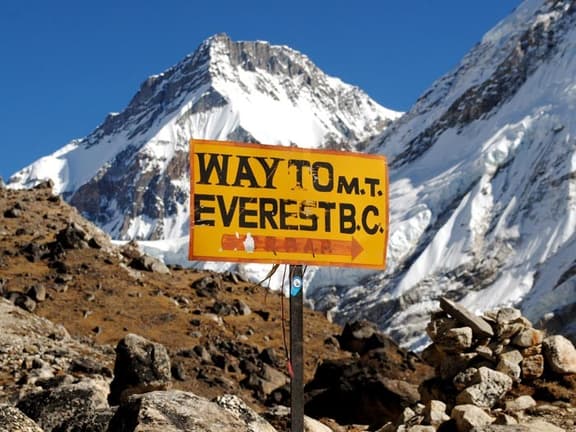
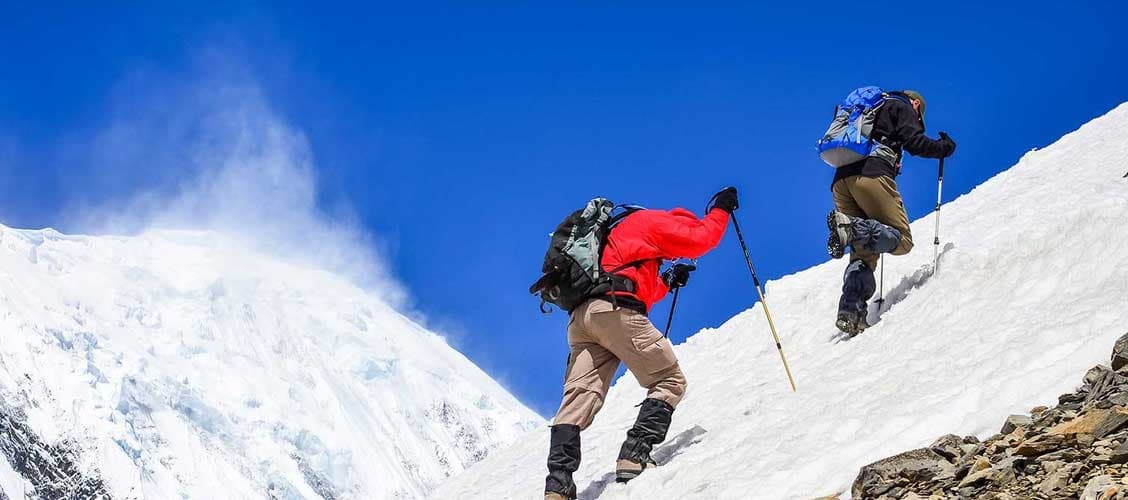
The 14-day Everest Base Camp trek follows the classic route: Lukla to Namche Bazaar through Sagarmatha National Park, an acclimatisation day in Namche, on to Tengboche Monastery, Dingboche, Lobuche, and Gorak Shep, then Everest Base Camp (5,364m) and a pre-dawn climb of Kala Patthar (5,545m) for sunrise over Everest. No climbing experience is required, and HSJ briefs trekkers on the Manthali/Ramechhap flight logistics ahead of the peak season, with the USD 300 direct helicopter-to-Lukla option available for those who want to skip that drive.
Trekkers who want more than the standard route can combine Base Camp with the Gokyo Lakes and a crossing of the 5,420m Cho La Pass on the 17-day Gokyo Ri & Everest Base Camp Trek, or go further with the 19-day Everest Three Passes Trek, which adds Kongma La and Renjo La for a full circuit of the Khumbu. For a full cost breakdown with budget, mid-range and luxury comparisons, see HSJ's complete EBC trek cost guide.
What If You Don't Want to Trek at All?
Not everyone has the twelve-plus days or the fitness for the full trek, and that's fine — Everest is visible without walking to it.
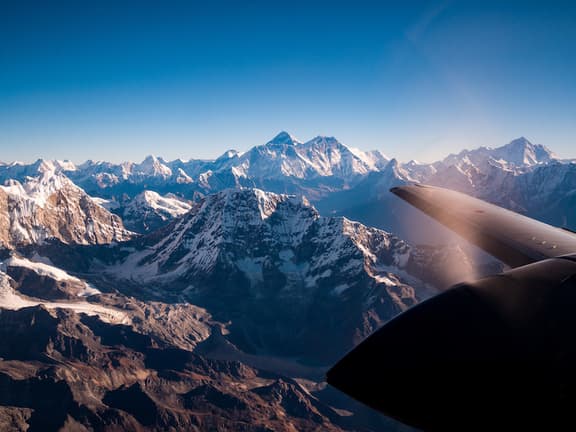
The Everest Scenic Flight is a one-hour flight from Kathmandu that passes within 32 km of Everest's summit, with views of Lhotse, Makalu, Cho Oyu, Kangchenjunga and Ama Dablam from the window — no trekking, no altitude preparation, suitable for almost any age or fitness level. For those who want to actually stand near the mountain without the multi-day walk, the Everest Base Camp Helicopter Tour lands at Kala Patthar and stops for breakfast at Hotel Everest View, taking about four hours round trip from Kathmandu. Browse the full range of options on the Everest Region page.
FAQ
Is it cheaper to book an Everest Base Camp trek in Nepal or in advance online?
Booking with a registered Nepali company directly — whether you contact them online in advance or in person in Kathmandu — is usually cheaper than booking through an international agency that subcontracts the trek to the same local operator anyway. Booking in advance is strongly recommended in peak season (March–May, September–November) so your Lukla flight and teahouse rooms are confirmed.
Can I trek to Everest Base Camp without a guide?
No. Since April 2023, Nepal requires all foreign trekkers to hire a licensed guide through a registered trekking agency for routes including Everest Base Camp. Independent, unguided trekking is no longer permitted in this region.
How many days do I need for the Everest Base Camp trek?
The standard itinerary is 14 days including Kathmandu arrival and departure, Lukla flights, and two acclimatisation stops. Trekkers who want to add Gokyo Lakes and the Cho La Pass should plan for 17 days; the full Three Passes route takes 19 days.
What's the best season to book an Everest Base Camp trek?
March to May (spring) and late September to November (autumn) have the clearest mountain views and most stable weather, though trails and teahouses are busiest then. December to February is colder but quieter, with direct Kathmandu–Lukla flights year-round outside peak season.
Do I need travel insurance for the Everest Base Camp trek?
Yes. You need insurance that covers trekking at altitudes above 5,000m and includes helicopter evacuation, since Base Camp (5,364m) and Kala Patthar (5,545m) are both above that threshold. A reputable company will ask to see your policy before departure.
What permits do I need, and does the company arrange them?
You need the Sagarmatha National Park entry permit and the Khumbu Pasang Lhamu Rural Municipality local Trek Card. A properly licensed trekking company arranges both and includes the fee in your package price, so you don't need to handle paperwork yourself.
Frequently asked questions
Is it cheaper to book an Everest Base Camp trek in Nepal or in advance online?
Booking directly with a registered Nepali company is usually cheaper than going through an international agency that subcontracts the same local operator. Book in advance for peak season (March–May, September–November) to secure flights and teahouse rooms.
Can I trek to Everest Base Camp without a guide?
No. Since April 2023, Nepal requires all foreign trekkers to hire a licensed guide through a registered trekking agency on routes including Everest Base Camp.
How many days do I need for the Everest Base Camp trek?
The standard itinerary is 14 days including Kathmandu arrival/departure and two acclimatisation stops. Adding Gokyo Lakes and Cho La Pass takes 17 days; the full Three Passes route takes 19 days.
What's the best season to book an Everest Base Camp trek?
March–May and late September–November give the clearest views but the busiest trails. December–February is colder, quieter, and has direct Kathmandu–Lukla flights year-round.
Do I need travel insurance for the Everest Base Camp trek?
Yes, insurance covering altitudes above 5,000m with helicopter evacuation is essential, since Base Camp (5,364m) and Kala Patthar (5,545m) both exceed that height.
What permits do I need, and does the company arrange them?
You need the Sagarmatha National Park entry permit and the Khumbu Pasang Lhamu Rural Municipality Trek Card. A licensed company arranges both and includes the cost in your package.