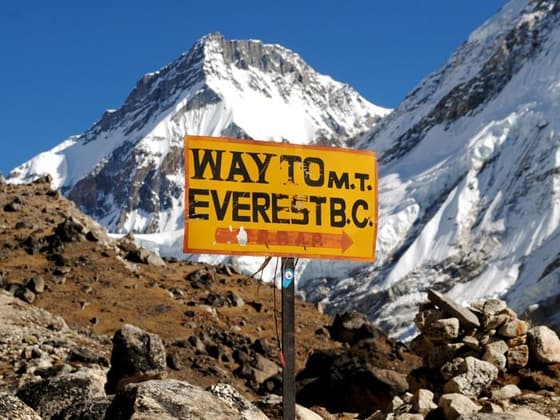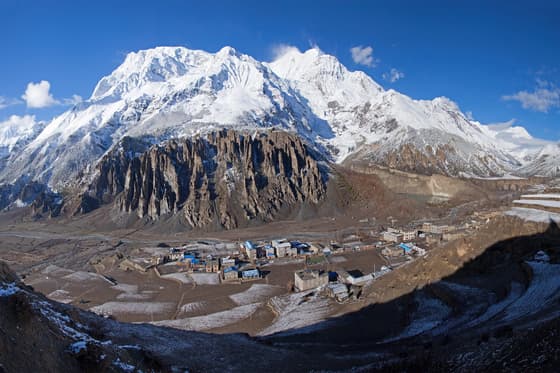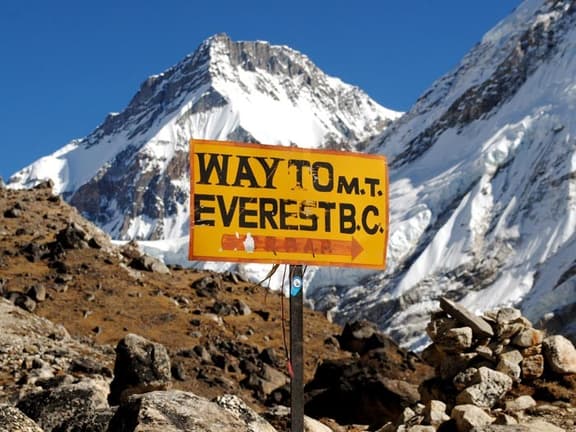
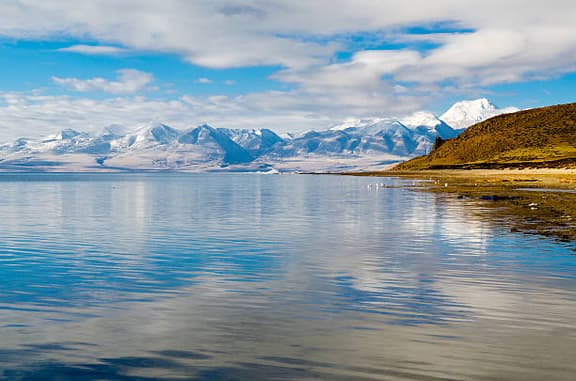

Photo: Marina Zvada, Pexels License, via Pexels. Trekking boots on a rock above Gokyo village and lake in Nepal's Everest region.
Short answer: for the Everest Base Camp trek and the Annapurna Circuit, wear waterproof trekking boots with ankle support that you've already broken in. Both routes go above 5,000 m on rocky ground and can be cold at the top, and HSJ's gear lists for both treks start with boots. For shorter, lower treks such as Ghorepani Poon Hill (3,210 m), well-gripped trail shoes can work in dry months if you already hike in them. Boots are the safer choice in the monsoon, in winter and on long downhill stair days. The route-by-season table below sets out each choice.
This guide is about which kind of shoe suits which route and month. For boot types, sizing, renting in Kathmandu and caring for boots on the trail, see our companion guide, Trekking Shoes for Nepal: How to Choose the Right Pair.
What does each route actually ask of your feet?
These route facts come from HSJ's current trip itineraries.
Everest Base Camp Trek (14 days): about 125 km in total from Lukla and back, usually 5 to 7 hours and 8 to 15 km a day. The trail crosses suspension bridges, climbs steeply to Namche Bazaar, and turns rocky and glacial beyond Lobuche, with the walk to Base Camp (5,364 m) along the Khumbu Glacier. Kala Patthar (5,545 m) is climbed before dawn. HSJ's trip notes say night temperatures at Gorak Shep can drop to –10°C to –15°C.
Annapurna Circuit Trek (14 days): about 160 km. HSJ's itinerary drives to Dharapani, then walks via Chame and Upper Pisang to Manang (3,519 m) for an acclimatisation day. Trekkers leave High Camp at 3 to 4 am to cross Thorong La (5,416 m), and the descent to Muktinath is more than 1,600 vertical metres in one afternoon.
Ghorepani Poon Hill (9 days, up to 3,210 m): graded moderate. The main feature is long stone staircases through villages and forest, via Ulleri, Ghorepani, Tadapani and Ghandruk.
Boots or trail shoes: the route-by-season matrix
Route | Spring (Mar–May) | Monsoon (Jun–Aug) | Autumn (Sep–Nov) | Winter (Dec–Feb) |
|---|---|---|---|---|
Everest Base Camp (5,364 m; Kala Patthar 5,545 m) | Waterproof mid- or high-cut boots. Main season. | Outside HSJ's listed seasons. Waterproof boots and gaiters for wet trails if you go. | Waterproof mid- or high-cut boots. Main season. | December is in HSJ's EBC season. Waterproof boots that fit over warm socks. Ask about snow before you leave. |
Annapurna Circuit (Thorong La 5,416 m) | Waterproof boots with ankle support for the pass and the long descent. | Outside HSJ's listed seasons. Waterproof boots if you go. | Waterproof boots with ankle support. | Outside HSJ's listed seasons. Check pass conditions. Boots, plus traction if your guide advises it. |
Short, lower treks (e.g. Poon Hill, 3,210 m) | Trail shoes with a grippy sole if you're used to them; light boots otherwise. | Waterproof boots. Stone steps can be wet and slippery. | Trail shoes or light boots. | Light waterproof boots for cold, damp mornings. |
HSJ's listed seasons are March to May and September to December for Everest Base Camp, and March to May and September to November for the Annapurna Circuit. The Ghorepani Poon Hill page lists February to June and September to December.
Can I do Everest Base Camp in trail shoes?
Short answer: we don't recommend it. HSJ's EBC gear list asks for high-ankle, waterproof trekking boots, plus camp shoes or sandals for the evenings and optional gaiters. The upper trail is rock and moraine. The Base Camp and Kala Patthar days start in the cold, and the itinerary has several long descents. If you walk most comfortably in trail shoes, bring them as a second pair for the lower valley and the lodges, not as your only footwear.
What about the Annapurna Circuit?
Short answer: boots. HSJ's Annapurna Circuit gear list says hiking boots (comfortable and broken-in), plus sandals or camp shoes. The pass day is the reason. You start in the dark from High Camp, cross 5,416 m, then descend more than 1,600 m to Muktinath. Boots that fit well matter more on that descent than anywhere else.
When are trail shoes enough?
On shorter, lower routes in dry weather, if you already walk long distances in trail shoes and they have a firm, lugged sole, they can be a reasonable choice. Ghorepani Poon Hill is mostly stone steps, so grip and a comfortable fit on descents count for more than ankle height. In the monsoon or on cold winter mornings, a light waterproof boot is the safer option.
How much do my shoes weigh into the Lukla baggage limit?
For Everest, it matters. HSJ's trip notes give the Lukla flight allowance as 15 kg per person, including hand luggage, and porters on HSJ's EBC trek carry up to 15 kg (one porter for every two trekkers). Wear your boots on the flight and pack only one light pair of camp shoes.
Frequently asked questions
When should I buy new boots for a trek?
Early enough to walk in them several times before you fly, including on hills or stairs and with a loaded daypack. Don't let a trek like EBC or the Annapurna Circuit be the first long walk you take in a new pair.
How do I know the fit is right?
Try boots on with the socks you'll trek in, ideally later in the day. Check that your toes don't touch the front on a downhill slope, that your heel doesn't lift much, and that nothing presses after an hour of walking. Our companion guide covers sizing in more detail.
What if I get hot spots during break-in?
Try different lacing, a different sock combination or a different insole first. If the same spot keeps rubbing on every walk, change the boot before you travel rather than hoping it will improve on the trail.
Do I need waterproof boots in autumn?
HSJ's EBC gear list asks for waterproof boots whatever the season. Streams, snow patches and frosty mornings are all possible at altitude, even in the main seasons.
Can I bring trail runners as a second pair?
Yes, as long as the weight fits inside your baggage allowance. Many people use a light second pair as lodge shoes, which also gives your boots time to air out.
Do I need gaiters or microspikes?
Gaiters are listed as optional for EBC. Whether you need traction for snow or ice depends on conditions at the time, so ask your guide at the pre-trek briefing, not months in advance.
Plan your route first, then your shoes
Choose the route and month, find your row in the matrix, and break in that pair at home. For the walk-through of what the guide checks at the pre-departure briefing, read At the Pre-Trek Kit Check. For a full packing list, see our EBC packing list.
Ready to choose a route? See the Everest Base Camp Trek or the Annapurna Circuit Trek for dates and a price for your group.
Reviewed by Amrit Sapkota, Himalayan Social Journey