
Annapurna Circuit Trek — 14 Days
Trip Highlights
- 14 Days / ~160 km — classic circuit around the entire Annapurna massif, from the subtropical Marsyangdi valley to the high-altitude Mustang rain-shadow desert
- Cross Thorong La Pass (5,416m) — one of the world's highest regularly trekked passes; depart Thorong Phedi at 3am and summit by mid-morning
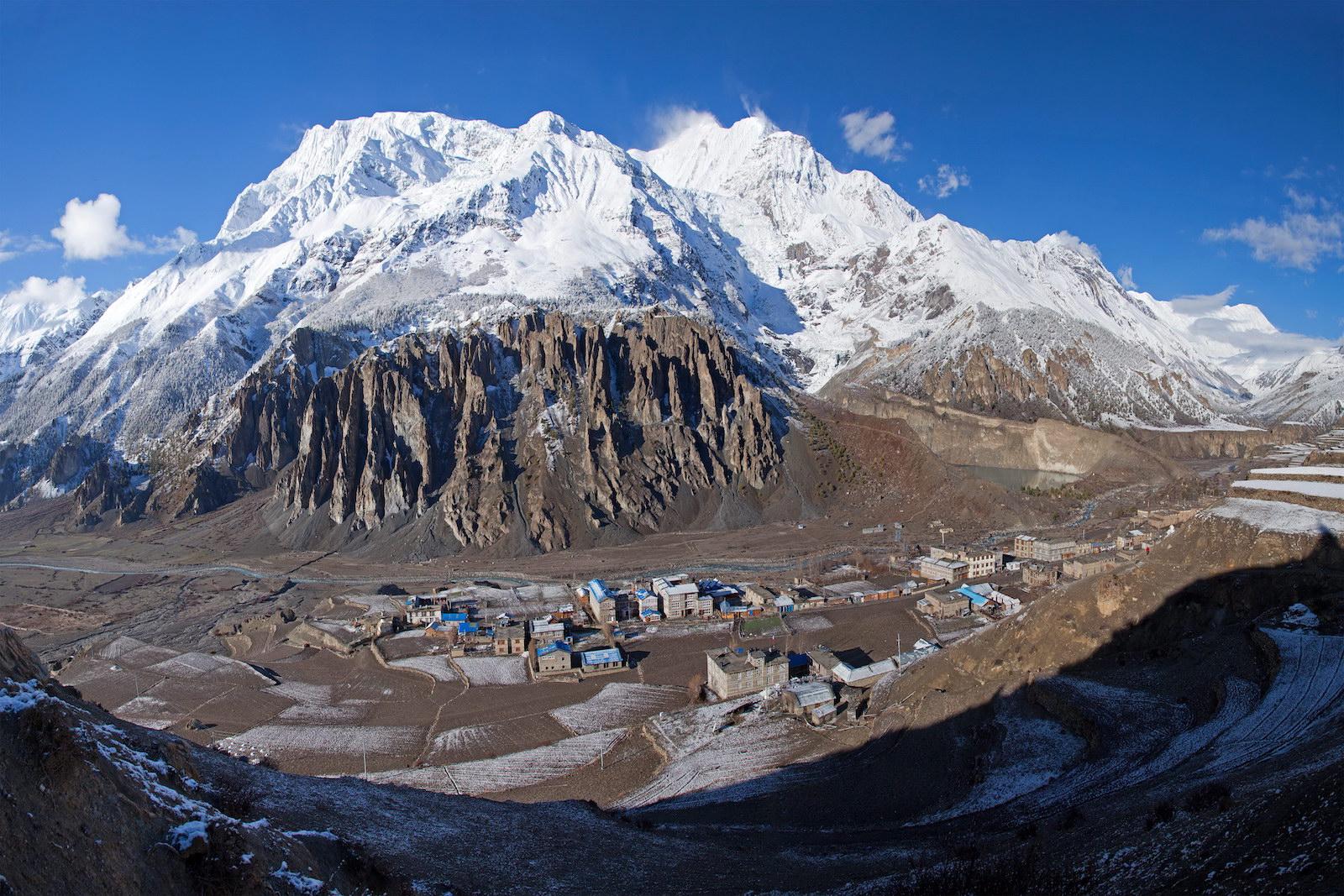
- Acclimatise in Manang village (3,519m) with a rest day; explore Gangapurna Lake and the views of Annapurna III, Gangapurna (7,455m) and Tilicho Peak (7,134m)
- Visit Muktinath Temple (3,800m) — a sacred pilgrimage site revered by both Hindus and Buddhists, with 108 water spouts and eternal flame of natural gas
- Remarkable landscape transition: subtropical rhododendron forest → high alpine meadow → stark Tibetan-plateau desert in the Mustang rain-shadow
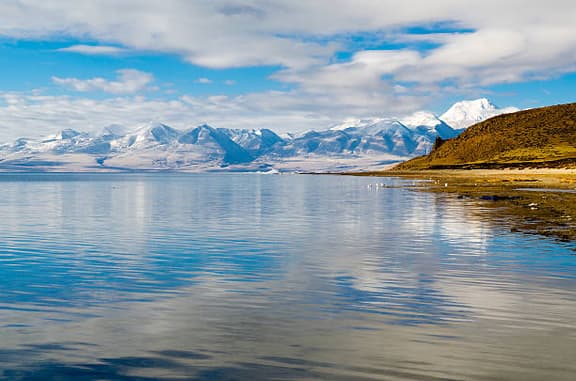
- Optional side trip to Tilicho Lake (4,919m) — one of the highest lakes in the world, with extraordinary reflections of the surrounding peaks
- Pass through living Gurung and Thakali villages — Pisang, Braga, Marpha and Tatopani — experiencing distinct cultures, foods and architecture along the route
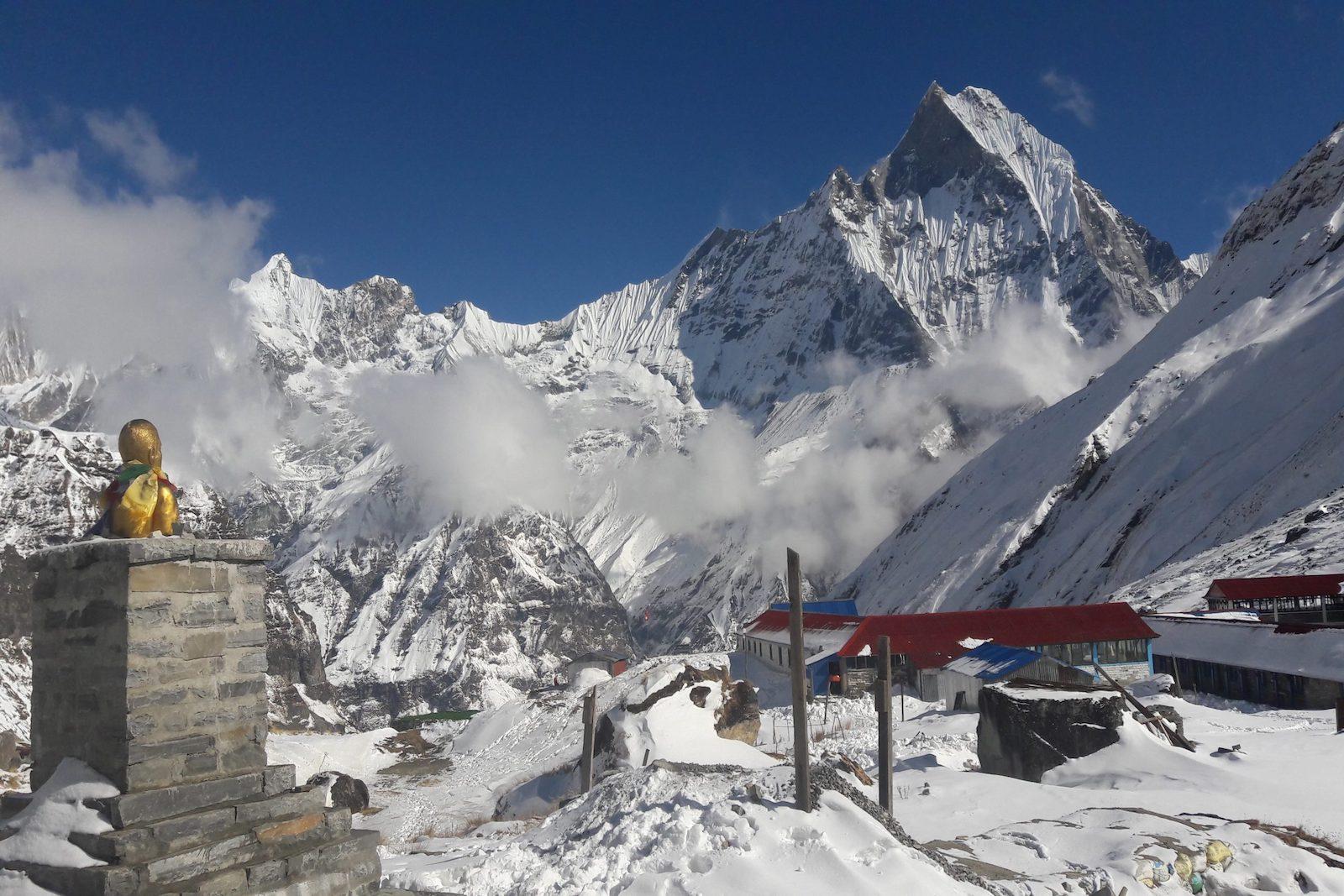
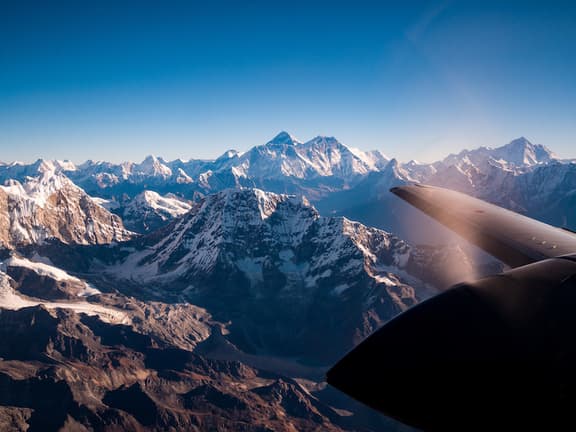
- Finish in Pokhara with optional scenic flight back to Kathmandu; Annapurna south face and Machhapuchhre visible the entire final descent
Trip Overview
Day-by-Day Itinerary
Upon your arrival in Kathmandu, our representative will meet you at Tribhuvan International Airport, extend a warm welcome, and transfer to your hotel. Take advantage of this day to adjust to the new time zone and immerse yourself in the lively atmosphere of Kathmandu. Orientation Program will be at 5 PM. After orientation program welcome Dinner with guide.
Today is your full day to explore the UNESCO World Heritage Sites of Kathmandu Valley with your guide. The day covers four iconic landmarks that give you a true sense of Nepal's spiritual and cultural depth.
Start at Pashupatinath Temple — one of the holiest Hindu temples in the world, set on the banks of the Bagmati River. Move on to Boudhanath Stupa, one of the largest Buddhist stupas in Asia, where monks circle the dome in a living expression of faith. After lunch, visit Swayambhunath (the Monkey Temple) perched on a hill above the city, and finish at the ancient royal city of Patan Durbar Square with its intricate Newari architecture and centuries-old temples.
In the evening, meet the rest of your group, attend a pre-trek briefing with your lead guide, and enjoy a welcome dinner. An early start awaits tomorrow — rest well.
After an early breakfast, we depart Kathmandu by private vehicle heading west along the Prithvi Highway. The 6–7 hour drive to Besisahar winds through terraced hillsides, river gorges, and rural market towns. From Besisahar, we continue by local jeep along the Marsyangdi valley — a rougher but spectacular road that follows the river upstream through villages and forest to Dharapani (1,860m).
Dharapani marks the official start of the Annapurna Circuit trail and sits at the boundary of the Annapurna Conservation Area. Settle into your teahouse, have dinner, and get an early night — the trekking begins tomorrow.
Beginning our journey from Dharapani, we will make our way to Chame, the administrative center of Manang. Along the route, we will pass through Danaque and tackle a steep climb that will bring us to Timang, located at the foothills of Lamjung Himal.
Today, after a warm breakfast, we will head towards Upper Pisang. We pass through a fir and pine forest, climb a high and rocky area. We will follow a trail to steep trail to Bhratang. After walking for a few hours, we will come up to a beautiful valley with a great view of Annapurna II as well as Pisang Peak.
Today, we will ascend a steep ridge to reach the Manang Valley via the upper trail through Nawal Village. From this vantage point, you will be rewarded with spectacular views of the Manang Valley and Tilicho Lake. We will then descend to Hungde, where the airstrip offers a stunning panorama of Annapurna III. Additionally, from the expansive plains of Sabje Khola, we will enjoy a striking view of Annapurna IV.
Acclimatization day. Today we spend a day acclimatizing in Manang. The whole day we spend by doing some fine day walks to Gangapurna Glacier or Annapurna III Base Camp or Monastery and overviewing the magnificent views around the village. And the daytime is best to gain altitude.
Today's journey takes us on a steep ascent through Tenki Manang, guiding us out of the Marshyandi Valley. We will follow the path alongside the Jarsang River, eventually arriving at Yak Kharkha, a picturesque pasture land where yaks graze freely. From there, we will continue our trek to Ledar, our destination for the day.
Today, we will depart from Ledar and set our sights on High Camp. The journey involves navigating a challenging trail, including a narrow path that crosses over the Kali Gandaki River. Expect rugged terrain with steep ascents and descents in several sections, making for a demanding trek as we progress towards our high-altitude destination.
Today presents a challenging yet rewarding adventure as we cross the Thorong La Pass, one of the highest trekking passes in the world. After navigating the strenuous ascent and descent, we will continue along the trail to reach our destination, Muktinath, where we can rest and reflect on our remarkable journey.
Today, in the morning we'll spend a few hours exploring the sacred site of Muktinath, immersing ourselves in its spiritual ambiance before resuming our journey. In Muktinath, you will visit Muktinath temple, one hundred eight water spouts and monastery. After a wonderful morning in Muktinath, you will take a Jeep from Muktinath and drive to Pokhara. Our journey will then lead us to Jomsom, where we'll settle in and unwind after a day of exploration and travel.
Pokhara, a treasure in Nepal, offers a lot of wonderful sights to explore in a little space. Begin your trip at Davis Fall, a strong waterfall whose thunderous roar dazzles everyone. Gupteshwor Cave, a fascinating cave with stunning rock formations and ancient legends, is nearby. Climb to the White Peace Pagoda, a serene location ideal for meditation or relaxation with stunning views of Phewa Lake and the Annapurna mountains. Then proceed to Pumdikot, a breathtaking vantage point with breathtaking views of the Pokhara Valley and neighboring mountains. Lastly, visit the Tibetan Refugee Camp to learn about the vibrant people there and to experience Tibetan culture. It offers a distinctive perspective on Pokhara's great diversity.
After breakfast, we will begin our journey to Kathmandu, opting for either a scenic drive by tourist bus or for a quicker option, an optional flight.
You will have your breakfast in the morning and the airport representative will drop you to the airport for your International flight as per your flight schedule. Or if you are staying Nepal for few more days, you can join another trip.
Route & altitude
14 days
What’s Included
Departure dates
Recommended Gear
Frequently Asked Questions
Best time to do Annapurna Circuit Trek is during spring (March-May) and Autumn (September-November). HSJ can however organize the trek at any time of the year with absolute saftey while still availing you to have memorable experience.
This package of Annapurna circuit trek is 14 Days long. The number of days can vary depending on the routes and transportation modes, offers and packages you choose. We can also customize this trek for you to finish in lesser days if you are short in time.
Altitude: 5416m This trek requires you to walk 5-6 hours per day with a light day pack. Walking in higher altitudes is more physically demanding than walking in lower altitudes, however, the pace of the trek will vary in compensation. If you are in excellent health with average physical fitness and have strong determination, you will complete a difficult trek successfully. Exercising, particularly jogging and climbing stairs regularly for some weeks prior to your arrival is recommended to enhance your strength and fitness. Past hiking experience would be an asset, but no technical skill is required. It is slightly challenging, uphill and downhill, walking close to mountain views and walking through the beautiful mountainous forests.
While it is possible to do Annapurna Circuit Trek independently, the need of guide is misunderstood often. Guide is more than just someone that helps you with navigation, guide with knowledge of locality, way of life and also being responsible to attend to your other needs like finding you comfortable accommodation. Having a porter will help you carry your gears and belongings and you can travel at your pace while enjoying your trek. A guide can arrange for permits and TIMS for you and dealing with all other technical aspects of trekking.
It is easy and safe trek that people can do this trek independently. Indeed, it is secure and not risky trek. While there is always the possibility of avalanche because it is in mountainous areas, this is usually not dangerous. It's not a complex walk, the pitch is not rough, no tough moves, no sharp hits. That said, accidents can occur on any walk, so caution is of course required. A responsive acclimatization is important.
You will have working network connectivity in most parts of the trails. However at the higher altitude, the network may become sluggish and unreliable. The stops at the tea houses will have working connection and most of them would have Wi-Fi connectivity too. You may have to pay some extra charge for Wi-Fi connection and electricity at the higher altitude.
Global passengers will be protected by insurance when treking in Nepal. Although Nepal is normally very secure, trekking at high altitudes is physically difficult and often risky. Altitude sickness is common during hiking tours in Nepal, particularly among foreign hikers who may not have taken the right time to acclimatize. Such rescue and related emergency procedures are costly and passengers are forced to pay for these services out of their pockets, unless they are covered by insurance plans.
The break during the trek depends upon the travelers and guide. Needless to say frequent breaks are needed while ascending. Only one break is taken for the lunch. Usually travelers carry their dry snacks which they can eat while on the trek and in between the breaks. There will be break to refill the water on the way.
Yes, Himalayan Social Journey is flexible travel partner. It is possible to organize the private trip or private group trip to Annapurna Circuit Trek. The minimum people for the group is 2 however supplementary charge will be applicable for the solo traveler wanting to do private trip.
Supplementary charge will be applicable for the solo traveler wanting to do private trip. You will also have the option to share the room with another solo traveler depending on your and their consent and interest. Even if you pay supplementary charge for the single room, it is possible that during peak seasons you will end up sharing rooms due to lack of availability of the room.
In the average, you will be walking for 5-6 hours each day during the Annapurna Circuit Trek.
Insurance of the guide and porter is covered by the company. All our guides and porters are properly insured.
Yes, children are allowed to do the trek, however it is safe to not bring children under the age of 12 to do the trek as they may find it difficult and not able to walk. This could affect your trekking experience as well. The altitude is also high as they may have risk of altitude sickness.
No, there is no age limit to do the trek. If the person is healthy and physically fit, they can do the trek. We have had elderly people over 70 this trek with us and hence we can vouch that older people can do this trek as long as they do not have significant health issues.
You will have teahouse or guest house accommodation while on the trek. Tea houses can be multi-story concrete buildings with private rooms in lower elevations. The higher you step up, the simpler the accommodation is. Accommodation will involve a single dorm space in the base camp. Guide will arrange for the adequate, clean and hygienic place for you to spend overnight and you will eat at the same place you will stay in. Most of the places shall have attached bathroom and hot shower however over the higher altitude, it is likely that you may have to pay extra sum for the same.
Liquid need of body while trekking is about 4-6 liters a day (16-24 cups). Several findings suggest that drinking carbohydrate and electrolytes (such as sports drinks) in a liquid is safer than moisturizing water at altitude alone. There is also a study done on the effect of tea in reducing the fatigue and mood boosting. Results have been positive. This being said apart from water, you can drink green tea, masala tea, and ginger tea and garlic soup.
The Tap water supplied along the trails are considered safe for drinking and local people drink it without treating, however for the foreigners, it is best that the tap water be only drunk after purification. There are two good options for having proper drinking water during the trek. You can bring water purification tablets or fill your bottle for a nominal fee from the recognized and regulated "pure water" stations along the trek. As the last alternative, you can also purchase bottled water at the lodges but this is not recommended. It is very important that you drink at least 3 litres of pure water daily during the trek.
You may have to apply and obtain necessary TIMS and Permits yourself if you are trekking solo or independently. If you are hiring trekking agency or guide, this will be taken care for you.
No, the company does not provide trekking poles, you will have to manage it on your own or our guide can help you buy it when you are in Nepal. The pair of trekking poles cost from $10-$15.
Yes, we do provide sleeping bags. The sleeping bags we provide are of good quality. They help you sustain the colder climate in Nepali mountains up to -20 degree Celsius of temperature. However if you need the one of your own, you can buy one here. Your guide shall assist you to get it here. Keep the track of the weather forecast of the area and pack your clothes accordingly. This would help you be prepared for the type of weather Nepali Mountains are accustomed to.
People generally describe it as - An unforgettable trek and experience to see mountain scenery, ever-changing landscapes, breathtaking picturesque nature and memories of mankind.
With consideration to altitude and route even though Annapurna Circuit Trek is considered moderate, people find both Annapurna Base Camp and Annapurna Circuit Trek, fairly same with consideration to the grade.
On the lower regions of the Annapurna Circuit trek, the weather is generally warm. The days have an average temperature of 15 degrees Celsius. The nights are slightly colder at 7-8 degrees Celsius. The higher altitudes are colder.
Traveler Stories
Traveler Reviews
Amazing views and our guide tiakaram was very helpful and funny 5 stars for him !! , amazing time I had . Me and my friend loved every bit of it
On our trek, we met the guide (Tikaram). He was accompanying a very nice Indian family in three generations were doing the trek. The oldest member of the family was 80 years old! An incredible achievement. I'm writing this review because we found Tikaram to be…
Read moreDuring my trek to Annapurna Base Camp, our guide stood out in the most unexpected and heartwarming ways. He wasn’t just leading us through rocky trails and snow-laced paths — he was quietly looking out for everyone. He’d carry people’s bags without being asked…
Read moreI want to thank Himalayan Social Journey for making ABC trek a memorable trek. Trek Guide TIKARAM ji and Sagar were helpful and supporting through out.
Compare Similar Experiences